June 7, 2015

Do like a Necromancer (Part 2): Touch

We touch everything we love.
   This is how we have experienced the world since birth. We touch. Collectors love their coins and want to touch them too. How else can we really connect with them?
   This is the way of the necromancer.
   Our fingertips are endowed with millions of nerve endings. They represent the center of tactility. A big hunk of brain is devoted to the sense of touch. And think about this: We have put our fingers just about everywhere else, so why not coins?
Go ahead and place a few fingertip coins out in the open.
Explore them with your fingertips, and when you have
guests, hand them over. Enjoy them, and let the Angel
cry out in agony, as you unleash your curiosity!
   Well, here is the rub. Literally. Collectors have been made afraid to touch their coins. We fear that our hands will be slapped by the Angel of Numismatic Correctness! "Never touch the surface of a coin," she says like a strict teacher wielding a ruler.
   This admonition is clearly stated in just about every coin collecting guide. Even a circulated coin should not be touched ... as it will melt away from the oils and grime caked on our fingertips. Ecch!
   Yet, we forget that circulated cents, nickels, dimes were handled for decades by careless and distracted hands. Some coins have been retrieved after being lost in the dirt. Other coins have been found at the bottom of the sea.
   Still, the no-touch coaching rings in our ears.
   Of course, we will not be so neglectful as a busy cashier or a pirate. Our coins are marvelous because we have taken the time to select each one for our collection. We will touch carefully.
   The first challenge of the would-be necromancer is to overcome the fear of retribution from the Angel. We want to be able to touch our coins without intense guilt, that if turned inward, could produce stomach ulcers, or worse, kill us with an aneurysm in the brain. I can imagine the headline: Coin collector found dead on the floor after touching his Morgan Dollars!
   If you have already engaged in the two-penny shuffle (a few weeks ago), then you are moving in the right direction. If not, then it is time to seek out some fingertip-coins. I recommend something heavily worn or corroded as a starting point. If you collect coins in a series, go out and get a nice worn piece to compliment your set. Or, get a ship-coin that has been savored as a curiosity -- sailing ships look great as they emerge from the mist of wear.
   Think of this as a desensitization exercise. It is one of the first lessons of the necromancer. You do not need to smash your thumb on the coin face, but you can if you want to. Instead, just explore it without any particular plan or rule. Let your curiosity be the guide. Follow the energy.

May 29, 2015

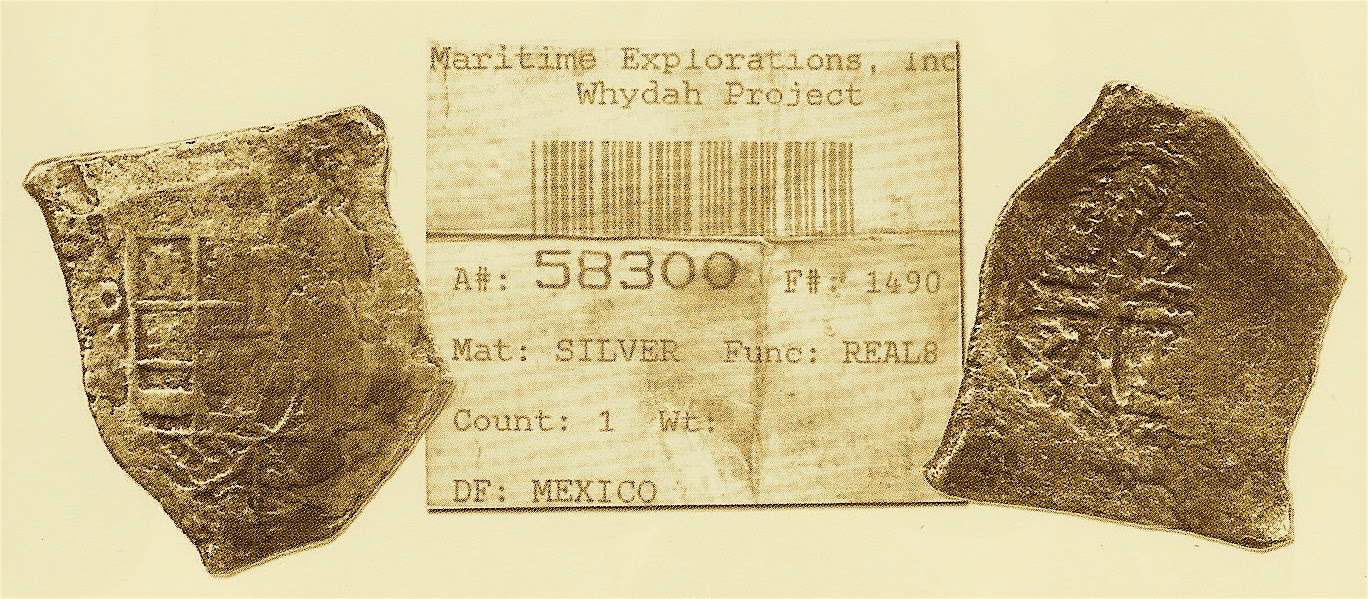
A Pirate Treasure Cob

Can a battered and corroded coin (or cob in this case) have a story exceptional enough to raise the value several fold? Well of course it can, particularly if it comes from a pirate ship.
   Coin World recently reported (May 25th) on a silver eight reales cob from the pirate ship Whydah that sold for $7K during a Daniel Frank Sedwick LLC auction held at the end of April. The ship sank off the coast of Cape Cod in April of 1717. The ship was originally a slave trader, but it was captured by "Black Sam" Bellamy just a few months before the catastrophe. Over four tons of gold and silver were onboard.
   The eight reales cob that sold was one of a very few pieces that has not been ensconced in a museum. Yet, the cob itself is relatively common; it is an irregularly-shaped hunk of silver in sea-salvaged condition. If the cob had been attributed to the 1715 Fleet (a group of galleons that sunk off the east coast of Florida), it would be worth $300 to $500. But the allure of pirate history sent at least two bidders into a frenzy -- and the price into the stratosphere. Of note, the same coin brought $7K in an earlier Sedwick auction that was held in 2011 --  it certainly held its value. The allure of pirates is enduring!
Here is the auction image from 2011. This ruddy piece is a magic piece
that in the right hands can send the imagination swirling with images of
pirates on the high seas. This hunk of stamped silver is animated.
                                                              Courtesy of Daniel Sedwick LLC.
   This is a dramatic example of how a story can transform a ruddy piece into a marvelous one. The drama of pirates -- with all the images in our heads of sword-play and skull-and-cross bones -- is too potent to ignore. And even if the images are wrong (per the historians who have studied contemporaneous accounts and who now think they have got it right), it does not matter. The stage is already set in our minds. We cannot get Jack Sparrow out of our head even if we wanted to.
   With movie images swirling in our brains, we want pirate coins, if we can get them. I cannot think of a coin collector who would not want a pirate coin.
   The significance of the story was not lost on Tom Sebring who originally won the cob at the 2011 Sedwick auction. He developed an exhibit and a presentation for ANA -- I saw them both. He also wrote an article for The Numismatist.
   The high value of the coin is all about the pirates. Yes, it is a rare piece considering that the other cobs salvaged from the Whydah are in a museum, but it is not a rare type of cob. Similar cobs that have been salvaged from the 1715 Fleet sell for much less (and they have a quite a dramatic story too). Plus, there are other cobs from wrecks that have produced few pieces that bring only a modest premium from collectors trying to get one from each ship.
   In this case, it is all about the pirates.
   This cob reflects that best attributes of the numismatist who studies history and is able to coax a fascinating story from a single coin. It also underscores the collecting approach of the necromancer. Coins with stories of having been spent and saved -- and in this case, stolen and sunken -- represent the exalted pieces that catch our fancy.
   This pirate cob also reveals the magic that is infused into coins by collectors who have chosen to collect them -- collectors vying for this one have made it marvelous.
   Not everyone can possess a rare bit of pirate treasure. After all, the Whydah has passed over into the marketplace. It has become popular. Some of us will have to settle for a cob from the 1715 Fleet. And some of use will have to settle for a worn coin that was spent and saved (and maybe not stolen or sunk). But still, these relics of human action are all fascinating in their own way. And none of them are new and shiny. Finding, and coaxing a story from, such pieces is the way of the necromancer coin collector.
   Herein lies the challenge: Go forth and find a marvelous piece -- cob, coin, token, or otherwise.

May 23, 2015

Loving the Unloved: Battered and Corroded Coins

Only a true collector can love the unloved. It is the way of the necromancer.
   Let's take a striking example: here is a battered and corroded coin. Can it be marvelous?
This old cent draws you in. It is beautiful for starters.
This cent has storyline that is familiar to us all: it was
lost, and it laid in the earth while the world churned;
then it was found again, blooming with corrosion,
and shouting out it story.
   Indeed, this heavily corroded cent caked with verdigris and exfoliating at the center is not likely to be found on a collector's want list. Perhaps it takes a rebel to collect something like this. It is clearly outside the accepted realm of the new and shiny. Yet, the necromancer enjoys battered and corroded coins such as this.
   And I assure you, I am not rebel.
   Instead, the necromancer sees something special in pieces like this. There is a storyline here: of being lost, perhaps hunted for, and now found. Some bloke lost this one over a century ago (maybe it was a dark night or maybe he tripped or ...).
   In any case, this cent was the still-point while life roared above it. Folks stepped on it. Moles dug past it.
   There is more.
   The storyline runs deeper, reflecting issues about mortality -- ours and our objects. Nothng lasts forever. We can feel it when we look at this one, even if the feelings go unexpressed.
   Once you get past the initial disdain (which is just a defense mechanism), you can't look away. Herein lies the allure.
   So why are such "heavy" coins unloved. I think it is because many collectors do not listen to their hearts (or their amygdala). Yes, too much cortex, too little emotion.
   The Angel of Numismatic Correctness pulls us away. Too bad. This is an object that is fascinating to ponder. It is a pure collector's coin, full of intrigue. It is marvelous!
   In her introspective book, In Fragrante Collecto, Marilynn Karp -- a Professor of Art, no less -- put it this way: "Of all the faces of collecting, this is the purest: collector and object, no intervening issues of value or competition, wholly unselfconscious choices." Indeed, loving the unloved is one of the hallmarks of the true collector. And the necromancer is standing right by his side.
   So why not collect battered and corroded coins?
   I submit that those who find magic in corroded coins are of a particular bent that is no less astute or fervent than the (so-called) connoisseur flashing his lustrous Morgan Dollars.

May 17, 2015

Collecting like a Kid

I was fortunate enough to have grown up when collectors were searching bankrolls and speculators preferred stocks. I hunted for old Lincoln cents and Buffalo nickels in pocket change. On rare occasions, I stumbled across a ruddy silver piece smoothed by a thousand fingertips -- a mute witness to decades of saving and spending.
   Now folks lament that the Golden Era of collecting has passed. The silver is gone. And, wheat-back cents are few. Nary a nickel dated prior to 1960 can be found. So, we gather together to sing nostalgic tunes while wondering if coin collecting will ever be the same.
This is Fun! Coins are Fun. Are you having Fun?
Or, have you lost the ability to appreciate a ruddy nickel?
   Slabs are everywhere. Mint products flood the marketplace. Circulating coins made of pot-metal offer little intrigue. But this is not why many collectors feel lost. Rather, they have been seduced by the Angel of Numismatic Correctness.
   Consequently, many collectors have allowed their brain to be white-washed into thinking that new and shiny is the only way to go. The best-selling coin books are filled with valuations. Coins are treated like stocks. So boring.
   Is this how you want to spend your leisure time up until the day you die?
   Once upon a time, a Buffalo nickel found in pocket change was reason enough to huddle together with friends. Everyone elbowed in to see and touch. An old coin looked old. It was exciting to imagine how it survived. The experience was so good that many of us (kids) spent our allowance on old coins. For me, this was a whopping $0.75! But, a cool Buff was only a quarter or less. A deal! 
   It was great fun to search for all the dates. Some nickels could be found, and some purchased. Some nickels just had the last digit showing -- but no matter, it was cool to be able to decipher it. The heavily worn pieces were interesting in their own right. Wear patterns, oxidation, odd nicks and scrapes -- these features added to the allure.
   Nowadays dealers label these coins as "junk" or (pejoratively) "collector coins." What does this clever phrase mean? Collector Coins. I guess it means junk.
   Too bad that many dealers have lost their soul. I see YNs, dressed in sharp suits and ties, sitting behind tables full of slabs at coin shows. They look serious, wielding fancy pens, spreadsheets neatly folded to the side, like stock brokers. A ruddy nickel never gets a look. Too bad. Instead, they obsess about full horns. Who cares about full horns?
   Did you know that some folks have paid big bucks (many allowances added together) for a 1926-S full-horned buffalo? Mushy strikes make the horn a coveted feature. Yet, rarely do you see regular folks elbowing in to inspect the horn. Such a beautiful coins reduced to a horn! Oxidation looks better.
   As for me, and the other necromancers, we want to explore old coins that look their age. These are the coins with stories. Collecting is most fun when we are driven by curiosity and imagination. Collector coins are full of intrigue.
   The way of the necromancer is to recapture this youthful exuberance. It is not about spreadsheets: gray, red, or otherwise. And, it is not about full horns.