November 8, 2015

Old Sails: Early Carrack on Krauwinckel Jeton

Jetons are great sources of ships. In this post I share one of my favorites: A carrack (or nao) with spectacular details.
   This counting piece was issued by Hans Krauwinckel II of Nuremberg (Germany) between 1586 and 1635. It is made of bronze alloy, measuring 29mm across. The mint (actually, guild) master's name is clearly spelled out in the legend: (cross) HANS (rose) KRAVWI NCKEL (rose) SCHIF. The word SCHIF translates: ship.
   I was unable to find this specific jeton in Mitchiner, but it is similar to 1597 and 1686a and is described as "Ship of Paris" sailing left. This ship was part of the Arms of the City (and it appeared in many forms over the years).
This jeton was set aside as a keepsake and well taken care of
for nearly 400 years. I wonder who owned it and how long it
set in a drawer before it was passed between collectors.
   The vessel is bold and has several interesting features to ponder. First, it is a fully-rigged ship with foremast, main mast, and mizzenmast. Each mast carries a single square sail, although one is tied, so we cannot be sure. Two sails are unfurled and billowing from wind blowing from right to left. Pennants atop each mast are flying in the same direction.
   Overall, the sails suggest a port tact. Hence, the bow is left on the coin. The mast on the right is the smallest and sits atop the aft castle. The three-layered castle heavy on the right as would be expected for an aft castle. The forecastle is shown with a railing.
   The hull is sharply curved with bold nails and planking. Carracks were typically carvel-built, but the bold rendering on this jeton gives the impression of a clicker-built hull, as the nails follow the board edges. Either way, the hull appears wide and deep.
   Carracks represented a combination of Mediterranean and North Atlantic ship designs. The fore- and aft castles were typically tall, producing a pronounced U-shape with the lower waist in the center. Carracks were fully-rigged with three (sometimes four) masts. By the mid-fifteenth century, topsails were added (this ship has none).
   All told, this ship is fascinating and beautifully engraved with many details.
   This jeton was issued at a time when counting boards were gradually being replaced by written tabulations using Arabic numbers. As such, jetons were becoming more popular as recognition pr presentation pieces. As such, the designs became more elaborate and attractive -- this was the high-point for Nuremberg jetons. Certainly, this ship design represented a significant improvement over the previously issued "ship penny" (depicting a single-masted cog) that was produced by the thousands in Nuremberg in the late 15th and early 16th centuries.

November 1, 2015

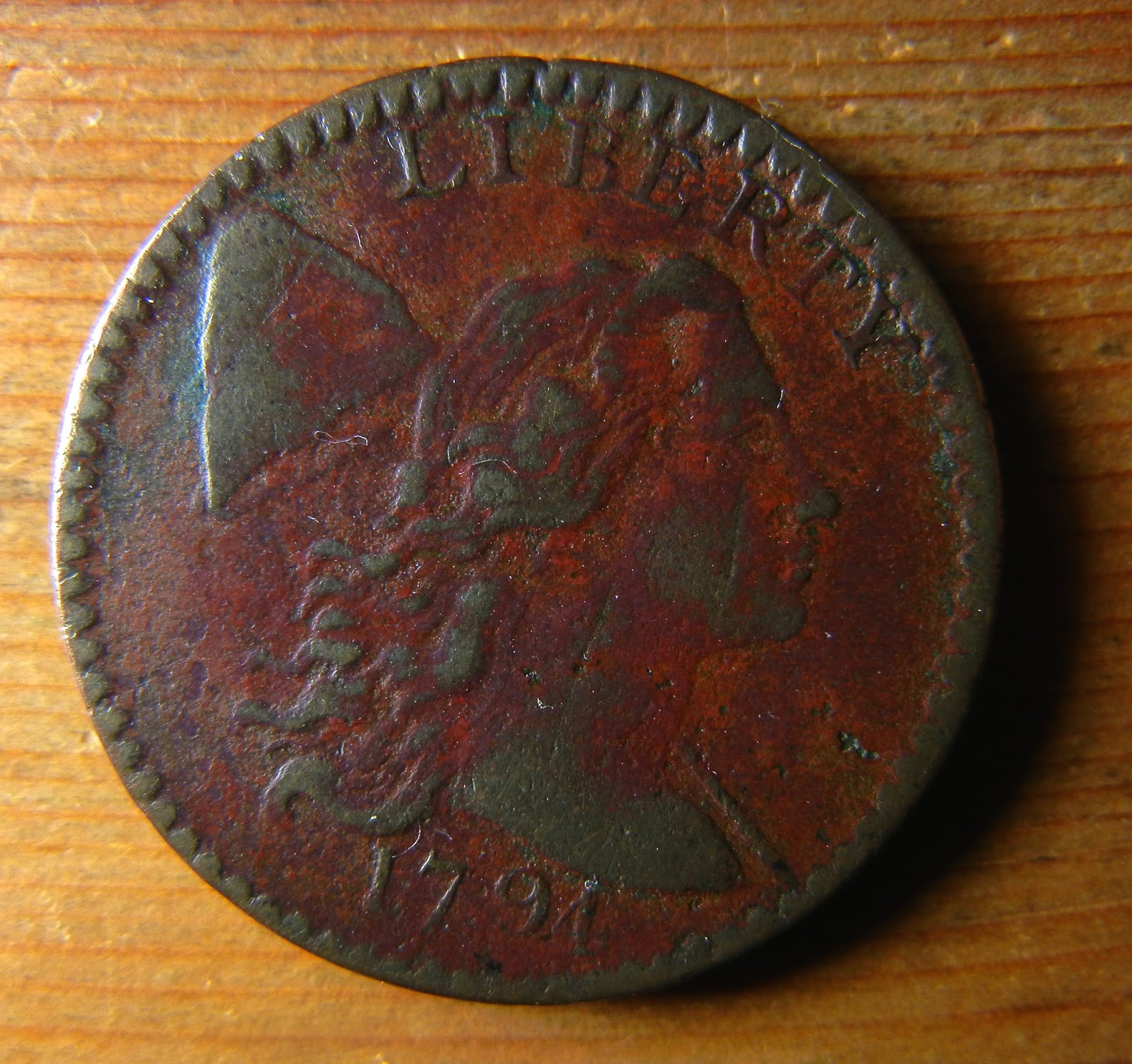
Loving the Unloved: A Red 1794 Large Cent (S-63). "Why don't you clean that thing?"

I am enjoying the Fall. The leaves are ablaze, and I am reminded of my favorite red cent.
   I had it out the other day to photograph it for my upcoming book that explores how battered and corroded coins impact us. They do! But in very different ways. I shall explain with a story.
   When I first discovered this curious cent (1794 S-63) at an Early American Coppers convention, I was awestruck by its deep crimson color -- and, it was a "fallen 4" variety to boot (one of my favorites).
   The blotched date reminds me of folkart: a widely-spaced 9, way too high and leaning left, crowding the 4, which is tucked between the bust and dentils. No wonder the variety has been called the "Drunken Diecutter's Obverse." The whole effect is struck on a very thick, meaty planchet.
   But it was the red corrosion that grabbed my eye at first glance.
Here is a gal that will run with you, not spend all her time in the bathroom
putting on make-up and practicing smiles.
Get real! This is what an old coin should look like.
   When I showed it off to a 1794 specialist -- not just any specialist, but a millionaire collector with all the best cents -- his first comment was: "You can get that red off ... " and he proceeded to describe some alchemic approach to turning back the hand of Mother Nature. The truth of the matter is this: this coin was a "dog" -- a scudzy, maligned piece -- to his eye (and in all fairness, to many other copper specialists as well).
   After all, corrosion is the death knell of copper cents. Never mind that the coin is brutally honest about the life of objects and the people that made them. And the red -- that wonderful layer of cuprite (with perhaps a dash of bornite and tenorite mixed in) -- this is the signpost of a coin that was dropped between the floorboards, or behind the hutch.
   Why clean it?
   Oh ... here's why: because the disease will continue to fester and devour the coin one molecule at a time. It is spewing off electrons as I write this. Oh, my! I hope the bank vault doesn't explode!
   Well, all I have to say is, "Hubba, Hubba!" I like honest coins. I want to face death.
   The leaves are falling outside. My body is giving out, one protein at a time. Why should I symbolically cheat death by paying large sums to get "perfect" cents. Or pay big bucks to own a "trophy" coin a few weeks just to be a numismatic hero? That is what most folks do. But this one, it is a keeper.
   I believe (as necromancers have known for a long time) that we are doing junior collectors a disservice by steering them away from the "red cents." Instead, many so-called experts teach collectors to obsess over every nick, blemish, and bump.
   Invest. Buy Smart. Look for Value. This hogs the popular literature. Learn to grade, learn to grade, learn to grade.
   Get real! Who cares if you do not make a dime! Numismatic heroism is overrated. Collecting timeworn and aged cents is where it is at -- leave the pretty, slabbed, over-priced cents to the anxious and (soon to be) disgruntled folks whose curiosity is blunted by the question: "How much is it worth?"

October 25, 2015

Collecting Jamestown: Part 1

I have decided to collect Jamestown.
   A couple of months ago, I did a three-part series on set collecting. Indeed, creating sets is the hallmark of the true collector. Governed by a few simple rules -- such as, each coin must play a unique role in the collection, and the no two alike criterion -- true collectors are meaning-makers, artists even, striving to understand their world one coin/one relic at a time.
   For coin collectors (albeit, those who chase after old pieces -- the necromancers if you will), the quote by Maurice Rheims captures the allure (see my post dated August 9, 2015). Here is the quote: "One of the collector's most entrancing daydreams is the imaginary joy of uncovering the past in the guise of an archaeologist." So true, so true!
   Now, back to Jamestown.
Inside the replica fort.
   One of the great things about being raised in the Tidewater, VA, area during the 1970s was that we got to visit Jamestown in the 4th grade. We piled on the yellow bus, and next thing you know, our class was crowding into the wigwams of Powhatan's village, climbing on the Susan (Sarah for some) Constant, and marveling at the ordinance within the palisades of the fort.
   But there was one disappointment: The actual location of James Fort was unknown at the time. I wanted desperately to stand on the hallowed ground, to stand on the bones of those who struggled to start the first English colony in the New World. And there were bones, as nearly 80% of the first settlers died during the "starving time" of 1609-10. In fact, the colony was briefly abandoned in June of 1610.
   So, where was the fort?
   Some said that it had washed away. This was only partly true, as unbeknownst to many, a seawall built near the old brick church had saved much of the fort. William Kelso, the Head Archaeologist of the Jamestown Rediscovery Project, suspected as much, and so the broad end of his shovel hit the ground in April 1994. It only took a few months to discover a line of darkened soil spots, rounded like timbers, that represented the remains of the south palisade of the fort!
   My childhood memories were sparked by this news. I finally visited Jamestown about a year ago. Wow! So many crusty artifacts had been unearthed -- including many coins and jetons. What a wonderful collection it was. Kelso described some of it as it came to light in his book: Jamestown: The Buried Truth. Other bits have been photographed and described on the Association for the Preservation of Virginia Antiquities (APVA) website.
   And so, I have decided to collect similar items as found at Jamestown. This idea has been percolating for some time now. I want to get as close to the actual objects as I can: same pieces, same condition, same relative numbers (within reason of course, as this does violate the no two alike criterion that shapes taxonomic  collecting -- but this is not that; and besides, collecting rules are meant to be broken).
   This, this is how a necromancer collects. And who knows what will happen when these pieces come together in my collection? Maybe something magical, something ghostly, something like the field of dreams -- I expect no less!

October 18, 2015

Battered Cob born of Scandal

This battered cob tells the story of a mint scandal.
   High up in the Andes, a mint was established by the conquering Spaniards at the foot of a mountain known as Cerro Rico. The name translates to "rich mountain." And it was rich: the slopes were filled with thick veins of silver, perhaps the largest silver deposit known on the planet. The city of Potosi was established and quickly grew to be one of the largest in the world with a population of 160,000 by 1650.
   Coinage began about 1573. The Spanish system of "renting" out administrative positions at the mint invited avaricious practices among greedy mint officials. These clever fellows debased the coinage. Hence, they filled their pockets with silver. The whole enterprise was hidden by the tendency to produce crudely struck coins (known as "cobs" or hunks of silver).
This 1652 piece-of-eight was the first in a series of designs
produced at Potosi to improve accountability. It is a bold cob
with strong strike but corroded by the sea. It is the perfect
relic with a great story that starts with greedy mint assayers
and their punishments, a  coinage overhaul, ending with
a Spanish galleon breaking apart on a reef.
   When the royal government discovered the cheat, Phillip IV ordered a series of investigations. One of the earliest inquires began in 1616. The result was a tightening of mining regulations, plus the addition of dates placed on the cobs (starting in 1617) to improve accountability. 
   But this did not improve the situation, and by the mid-1640s, the problem had worsened. The cobs from this period were under-weight and choked with base metals. The dates were barely readable on the cobs, as they were so crudely struck.
   New investigations were started in the late-1640s that resulted in a complete overhaul of the coinage. In addition, several mint officials were put behind bars -- plus at least two were strung-up by their necks.
   This cob is the first of the new coinage that began in March, 1652. This piece is one of my favorites, as the design presents a bold take on the old pillar-and-waves motif that boasted of Spain's claim to all lands discovered in the New World. The crowned pillars represent the pillars of Hercules marked by the straits of Gibraltar. The motto -- plvs vltra -- translates to "more beyond" and refers to all the lands across the Atlantic. The phrase is a shrewd re-wording of non plvs vltra found on pre-Columbian maps that suggested that no lands existed beyond the ocean.
   There is more to this story, but for now I invite you to enjoy the cob. It is a nice round one with a strong strike that has been eroded by the sea. As such, this piece-of-eight came from a sunken galleon -- I would guess it to be the Capitana that broke apart on the reefs off Ecuador in 1654. This ship wreck has produced most of the so-called transitional cobs of 1652.
   There were several distinct design-types of cobs produced throughout 1652, as the mint officials were tasked to come up with a design that insured accountability (as was done in 1617). By the end of the year, they had developed a design that showed the date, mintmark, and assayer initial no less than three times! This particular cob represents the first in the series of 1652 transitional cobs. It is a storied relic for the coin collecting necromancer.