November 17, 2016

Old Sail: Is it a Fluyt ?

Here is an old ship that might be a Fluyt.
   In the late 17th century a new Dutch cargo ship was launched. It was a fully-rigged ship with three masts and square sails. The hull had a relatively flat bottom with broad beams, and a rounded stern (some say pear-shaped). The largest fluyts were about 300 tons and 80 feet long. They sailed well into the next century.
   These ships were economical to build and could be manned by a small crew, perhaps a dozen mariners. Consequently, they were not heavily armed. But some fluyts had guns, particularly as pirates quickly learned that the fluyts were easy targets.
Twelve-skilling from Danish West Indies.
Is this ship a fluyt?


Today we examine a 12-skilling piece from the Danish West Indies (DWI). It is small coin (just a bit larger than a dime at 3.2g) made of .500 silver. It was a cheap alternative to the Spanish real that was the same size but made of finer silver.
   Skillings circulated in islands of St. Thomas, St. John, and St. Croix (now the U.S. Virgin Islands). The Danes initially settled on St. Thomas in 1666, but established a fort there in 1671 when the DWI was first chartered.
   Many of these skillings have been dug along the east coast of North America, so the coin is considered part of the American colonial series. Consequently, they are popular among collectors (especially as the legend includes "Americansk"). Most specimens are quite used up, as they were popular back then too. Twelve-skilling pieces like this one were produced across four years: 1757, 1763, 1764, 1765. Other denominations minted about the same time (six and twenty-four skillings) show the ship too.

So is the ship on the coin actually a fluyt? It is hard to say. It is a fully rigged ship with broad beams. The stern shows a slight curvature that is suggestive of a fluyt, but it is a judgment call. If it is a fluyt, then this is one of the few coins to show a Danish one.
   Another alternative: The ship could be the Fridericus Quartus. This was a ship of the line with many guns. The ship on the coin shows gun ports -- big guns! A fluyt might have a few, but they would be more prominent on a first-rate ship. This is a mystery. If you can solve it, let me know.
   Of note, the Fridericus Quartus did serve as a cargo ship. I found a reference to it that described its cargo in 1761. It returned from St. Thomas with 711 barrels of raw sugar, 10 barrels of cotton, 8 barrels of rum, plus 11 casks and 23 sacks of coffee. This cargo accurately describes the products of the DWI. The closeness of the date to our featured coins makes this ship a contender.

In any case, I think every old sails collector needs one of these. They are available but hard to find with the topsails clear of the fog.

November 12, 2016

Warning: Coin "slabbing" kills the buzz & makes collectors dumber: Part 1.

Warning. Do not touch the slabs!
   Yes, those plastic holders will destroy you.
   I don't think you will die on the spot, but you risk losing the passion that drives your collecting. You risk losing your "flow."
   Slabs are a buzz-kill. They are just as bad as cigarettes. Worse.
   Not only do slabs separate the collector from the coin by siphoning energy away from the collecting experience, but they fail to keep their promise. I focus on this latter point first, as it appeals to our rational frontal lobes (that unfortunately are being given precedence over our deeper, more emotional brain structures that govern the best that collecting has to offer -- more on THAT later).

David Bowers recently sounded the alarm. Writing in Coin World (CW) several times this past February he lamented that grade inflation has become rampant: in fact, many AU-58 coins are now graded MS-60 and MS-61. What about the rub?
   More alarming (particularly for the necromancer who relishes a coin that circulated), many VG-8 coins are being upgraded to F-12 or VF-20 --  here, Bowers referred to Indian Head cents. He found slabbed coins in the F-12 to VF-20 range without all letters of LIBERTY showing. These letters define the lower bounds of the "fine" grades.
Here is the lowest grade St. Patrick "Farthing" known.
It is a dug coin full of intrigue.
Does it help to know that it is a Poor-0.5?
   Bill Eckberg (President of the Early American Coppers Club) went further, writing in the November 14th edition of CW; he pointed out that crack-out upgrading tends to foster a tendency for many (if not most) coins to end up over-graded. He described an instance when a 1916-D dime was resubmitted over twenty times before being upgraded from MS-64 to MS-65.
   Alarmed?
   Surprised?
   Don't be.
   This kind of unreliability in grading is bound to happen across multiple resubmissions. We all know that condition grading is a subjective judgment. Consequently, errors are made in both directions. But the crack-out submitters typically stop when the grade goes up.
   The remedy for collectors who are ready to buy is to look at the coin, not the label on the holder. Bowers and others have urged buyers to examine the details -- yes, count those letters: L-I-B-E-R-T-Y.
   But collectors are not doing this.
   First, they are apt to trust (or strongly want to trust) the holder when the grade is inflated and the price is "right." Why not? A higher grade means you have benefitted. Second, some collectors are incompetent graders. Furthermore, they are likely to get confused when they compare slabbed coins with the actual grading standards published by ANA. Third, some collectors do not take the time to examine the coin beyond a cursory glance. They are lazy; they are satisfied with the "number" on the label (see #1); or they have already moved on to the next coin.

Well, I believe that slabs are bad.
   They are bad for all their failed promises. They were touted as the "last word" -- a stout holder, labeled with an objective assessment, that was to last forever. But there is more: the psychological damage is worse! Aside from making collectors dumber, they rob collectors of the positive emotions that come with discovery; they rob collectors of curatorial skills; they foster anxiety about market forces; they foster guilt (and cognitive dissonance) that comes with gaming the system; and they undermine the flow that characterizes the process of examining and comparing coins.
   So sad.
   I submit that numerical grading is a minor element of collecting. A convenience that allows quick communication. Short-hand. Nothing more.
   Necromancers -- all true collectors really -- do not rely on condition grades to determine the "value" of a particular coin and its role in the collection.
   Only dumb collectors rely on condition grades.

November 6, 2016

Down the Rabbit Hole: Expo Coin Immersion and a Snickers Bar

My eyes need a rest, as I have just returned from the Baltimore Expo. I examined perhaps a hundred coins, all of them up-close through a tiny magnifier lens with a hot lamp at my cheek.
My feet need a rest too. I walked all day, up and down aisles of tables, navigating an urgent crowd, all of them hunting for that special coin.
I also gave a presentation on Jamestown, telling stories about bent, holed, and folded coins that were magical. I was “on” and the hour seemed like minutes.
All of this was great fun, but it left me hypoglycemic. I had to run out for a Snickers bar – actually a Snickers first, then a sub.
Yes, the Expo is quite the immersion experience.

Dumpster Diving at the Expo
It is the tenth planet. Actually, it is a thousand different tenth planets.
Each collector has their own orbit, a grand vision, unique to them. And of course, each of us is relentless in our pursuit of the next coin – a want list in every pocket.
One man collects a single type of jetton (in copper, silver, whatever he can find). Another seeks medals depicting George Washington (medals, tokens, all of it). I even met a guy who collects “bridges” on coins (he is an engineer by trade – if that helps). And so it goes.
I like coins similar to those found in the dirt at Jamestown. Plus, other dug items. Relics – yes, that is my orbit -- lots of dumpster diving.

Each one of us has slipped down the rabbit hole.

You do not realize this when you are on the convention floor. How could you: everyone has a magnifying glass; everyone is hunting for the next one.
But, when you exit the big room, go up the stairs towards the sunlight, and press hard against the heavy glass doors, then you see. Like a rush of gale wind in the face, you are confronted with a whole world of non-collectors, just as urgent – cars honking, sirens wailing, shoes scuffing on pavement.
They have no idea what is going on in the convention center.
And, they don’t care.
The contrast is jolting.

I contemplated all of this while eating a sub at Jimmy Johns: No one out here cares about Jamestown or Washington!
If they were coaxed – and it would take some coaxing – to investigate the big room, many of them would think we were mad. But of course, they would be polite about it and remark that collecting seems like a nice respite from the hustle of life. (My wife puts it this way: “It is your break.”)

The problem is that I am not sure if I am breaking when I go out into the sun, or if I am breaking when I am peering at a relic through the lens.
I suppose that I am lucky in this way: frequently hypoglycemic and running out for Snickers.

October 27, 2016

Jamestown and Baltimore Expo

I went to Jamestown (yet again) last week.

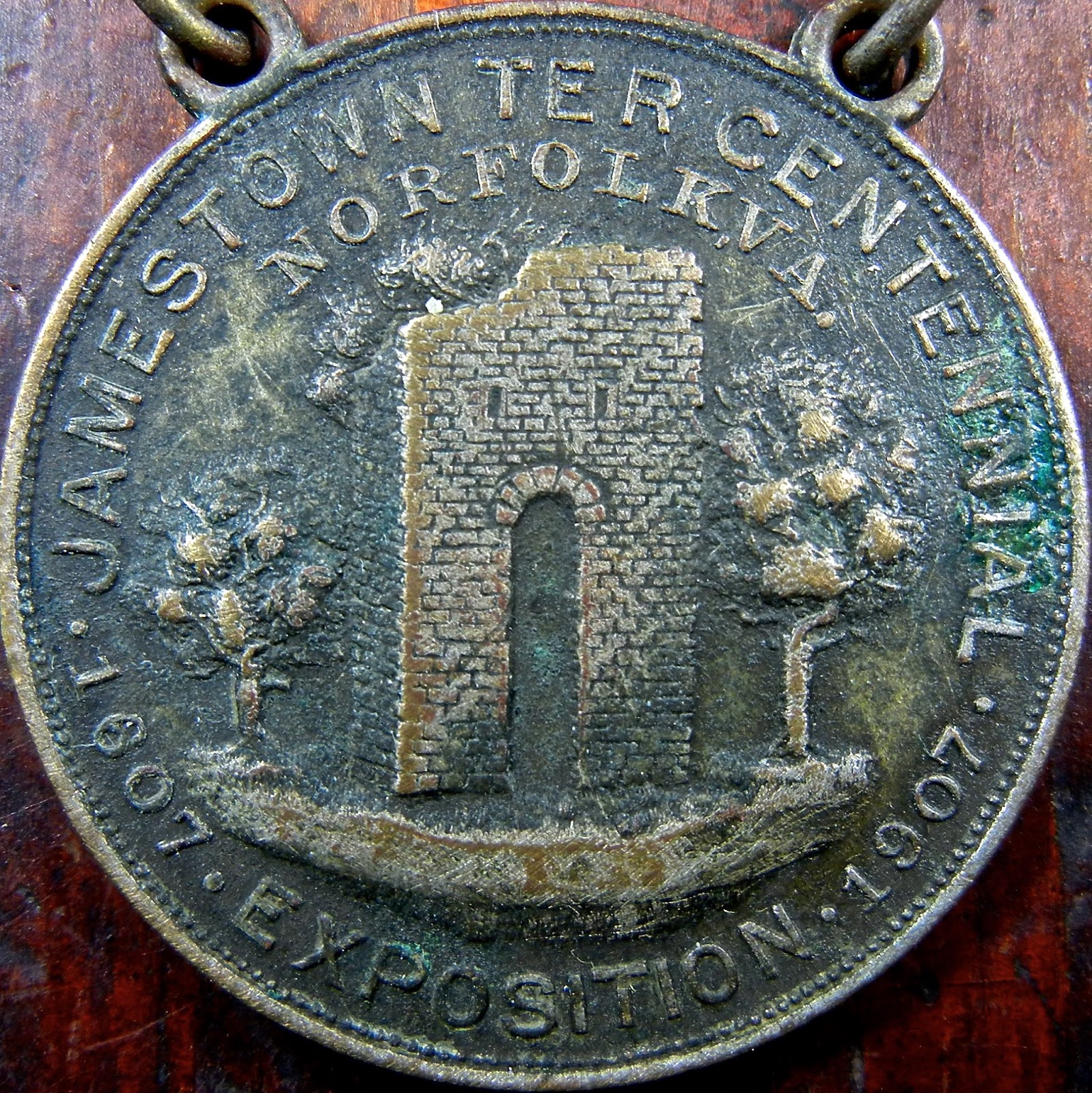
This old medal from the 1607 tercentennial exposition
has corrosion and wear in all the right places.
I find it oddly relaxing -- walking around this hallowed ground. So much misery was felt in this place that I am not sure how to label the mix of emotions: the pit that gnaws at your stomach whenever you walk about the 33 graves along the southwest palisade wall (all from that first autumn of 1607), the whirling of colonial images in your brain (Captain John Smith shrewdly bargaining with Powhatan), and the salty morning breeze of the James that cools your cheeks.

I keep coming here. I have been here many times over the years (six visits in 2016 alone).

I keep reading about the place, and then waiting for the next book to come out.

I have been particularly engrossed in the colonists' interaction with the supernatural. Yes, that's right, the supernatural: religion, magic, divine provenance, devils, bewitching, and so on. And so, I decided to talk about it.

I am presenting a small program at the upcoming Baltimore Expo: Friday, November 4th, 11AM. It is called: Bent, Holed, and Folded: Coin Talismans at Jamestown. If you are going to the Expo, I invite you to check it out. It is part of the program for the Colonial Coin Collectors Club (or C4), but the talk is open for all comers.